I wish to preach, not the doctrine of ignoble ease, but the doctrine of the strenuous life, the life of toil and effort, of labor and strife; to preach that highest form of success which comes, not to the man who desires mere easy peace, but to the man who does not shrink from danger, from hardship, or from bitter toil, and who out of these wins the splendid ultimate triumph. - Teddy Roosevelt, 1899
There a lot of interpretations and philosophies about that TR speech, but for this particular space, I am just focusing on thoughts and stories about the outdoors that are of course, "Bully!"

Rough Rider Spirit

Rough Rider Spirit

Friday, April 6, 2018

Pulp Non Fiction: All The Beauty and Truth You Can Stand for $9.99.


I have been wanting to try to write a book for a while now and the ideas for this project came along easy enough:

1) There really are very few books about the Cumberland Plateau.

2) I have a lot of adventure stories about the Cumberland Plateau, and I could mix them in with a lot of other educational facts like history and ecology lessons. Fun stuff!

3) I bet the book will pretty much just write itself.

I was right on the first two points anyway. Two years later, here we are. The really crazy thing is, because I write a detailed story about almost every hike anyway, the content was probably 50% finished before I even began.

I have had so many maps and notes spread out in the dining room that it looked like I was planning an invasion of Crossville.  There has been a cardboard box full of proofs, and drafts, and drafts of proofs, and proofs of drafts, sitting at my kitchen table for the better part of a year. I have named so many Word files and Adobe files that I am going to have to start using exponents. I have seriously worried that the mountains were going to erode into the ocean before I finished. But somehow or other, I got it done.  Here are some of the lessons I have learned along the way:

1) Yeah, it is nothing like writing a blog.  I can’t ever remember working for a month on formatting a blog post or worrying too much with sources. But I will have to give a shout out to my Amazon Overlord for making the process easier.

2) All of those authors that churn out a book or more every year….they don’t have a team of proof readers and editors working behind the scenes, they have an ARMY.  On the final and 708th review, I had about 78 errors to correct…on a 130 page book.  Is it perfect now?  HECK NO. It is in English. It is legible. I think.

3) It ain’t about the money.  Even I sold 1,000 copies, which is ridiculously unlikely, considering the time I have put in, my profit would work out to be about the hourly minimum wage, in 1795. 

So, in short, if you are looking for a quick-read piece of travel literature that will enrich your life beyond the bounds of your wildest imagination, look no further. It’s available on Amazon (Prime too!!!) at:

https://www.amazon.com/Seem-Have-Been-There-Before/dp/1543196691


Or just search Bill Parnell. I ain’t gonna lie.  It’s pretty cool to 
see your work pop up in an Amazon search.

So if you get a chance, buy a copy, or a few dozen! And don't forget those super positive Amazon reviews! Can you do a six star rating now? I didn’t include a critical review on the back cover, but if I had to write my own it would be something like…..


“Bill Parnell has once again pushed the limits of human artistic achievement. Seem To Have Been There Before possess both the humor of Bill Bryson’s A Walk in the Woods as well as the epic plot devices of Tolkien’s The Lord of the Rings, all bound together with Shakespearean prose and really neat maps.”   


Wednesday, March 14, 2018

Reading Walden: Yes We Can!!!


Sometime in high school, every single one of us was told to turn to ___ page in our American Literature textbook and read a one or two paragraph exert from Henry David Thoreau’s “Walden”. Let’s be honest, most of us probably didn’t read it. Full disclosure, I loved high school English so much that I still read the same books for fun. But even for an appreciator of classic literature such as myself, when it came to Thoreau, I really didn’t get it. (Of course, never mind the absurdity of exposing 15 year old kids to some of the greatest works of human civilization, and then chastising them for not getting it.) So back in the fall when I read an article that discussed how Walden was Teddy Roosevelt’s and John Muir’s favorite book, I thought, “Hey, I have got to give that Thoreau another shot.” So for $6 on Amazon Prime, I got my copy of Walden and Civil Disobedience. I stuck it in my hunting gear bag, determined to read it slowly over the course of the fall while deer hunting. Because shouldn’t you read a book about being in the woods while you are actually in the woods?  By the end of the season, I still had a good 200 pages to go, so I finally sat down and finished it.  It was a little bit of a challenge in the beginning but soon I loved it so much that I would always have to have a highlighter or pen around to underline passages.  Here are a few observations for encouragement:

1) On the whole, it is actually easy to read.  Yes, there are some confusing tangents, but those are typically tied to cultural references that seemed very appropriate at the time.  He was writing this for an 1850’s audience. So imagine if you wrote something referencing the Kardashians today, wouldn’t it be confusing to a reader in 170 years?  WE HOPE TO GOD SO. 

2) Because there is really not much of a plot, it is easy to pick up and put down.  It is organized into chapters, but it really isn’t necessary to even read them in order.  Although the last part, titled Conclusion, should be read at the end. 

3) Don’t be surprised if it starts to affect your behavior. The simple living message got me to cut off my cable and cancel my satellite radio. Now sure, I still have HBO GO and unlimited cell phone data for music streaming, but I had those before!  I mean, I am not becoming a total Neanderthal.   

I will say it was funny that I made my first visit to Ikea after finishing the chapter called “Economy”. As I walked through the city of furniture, I kept thinking about Thoreau’s anti-furniture rant.  He only had three chairs, “One for solitude, two for company, three for society.”

Anyway, for $6, it is worth giving it a shot.  Stick it in your bag and bring it out when you are waiting in a deer stand, or an airport, or a doctor’s office.  At worst, you will at least look pretty smart.  At best, no matter the outcome of your initial activity, you can at least say, “Well, I did read five pages of Thoreau.” And you have won the day!

Saturday, January 20, 2018

Ulra Crazy = 25K of Fun


In the long running quest to keep my pants fitting as I age, I try to run one Big Race a year.  Personally, I define a Big Race as a half marathon distance or more. I ran my first half marathon in 2003, and most years since, I have either run a Big Race, or trained for a big mountain trip.  As the time for the most recent running endeavour came along, I realized that it would be my tenth Big Race. I have previously run eight half marathons (including one trail half marathon) and one full marathon. For my tenth race, I wanted to branch out and do something different.  In the past several years, I learned to appreciate trail running. There is a decent network of trails close to my house, and any time in the woods is time well spent.  And the trail races that I have done have all been really enjoyable experiences.  It is hard to explain to someone who has just done road races, but the pace and expectations on trail is very different.  You will be walking some, and it's ok!

Of course, when you get into serious trail running, the Ultra world is where you end up.  It seems pretty intimidating.  The distance numbers are so large, you don't even have a concept of how far that really even is.  So, for my first Ultra, I choose an Ultra "lite", the 25K.  A standard full Ultra is 50K, so I think the 25K is equivalent to the half marathon, but considerably harder.  25K is 16.3 miles, which is further than I have run since my full marathon in 2005. I knew the pure time and distance of it was going to be a challenge, never mind the unpredictable trail conditions.  When it came time to pick an actual race to train for, I had two options that were close to me, The Bell Ringer at Montgomery Bell State Park (in December) and the Swamp Stomper at Meeman Shelby Forest State Park (in January). The Swamp Stomper worked in my schedule better so I started training in early November.

Of course January weather is crazy unpredictable. And of course the race ended up being held in the aftermath of a pretty bad winter storm, for West Tennessee anyway.  The trail was covered with ice and snow and the temperatures were in the teens at the start. We had to painstakingly pick our way down the steep hillsides and towards the end we were crawling on our hands and knees on the hill climbs because it was too slick to even stand up.  I finished about 45 minutes slower than I had wanted, but I finished. Here are some of my thoughts about the experience:

1) My training was pretty manageable.  In the past, I have trained for trail races by pretty much training for a half marathon and maybe running some short trail runs here and there.  This time I ran my 4 mile speed runs on the road, and all of my long runs on trail. I only got up to a 10 mile trail training run, but I know I should have topped out on a little longer distance.

2) My shoes were da-bomb (I have a license to still say that). On a lark last spring, I used my R.E.I. member coupon and dividend to get some real trail runners. I ended up getting a pair of Merrell All Out Crush.  They are not quite ultra light shoes, but there is significantly less to them than most Hoka Ones. They have soft soles with almost cleat like treads and meshy uppers. In fact I actually wore them while coaching soccer this fall and ran drills with the kids. This summer I also took them on a day hike in Colorado and was very impressed. On race day, when we were going down the steep icy slopes, the folks with Hoka Ones were sliding every which way. My steps were staying firmly planted. In fact, over the whole 16.3 miles, I only fell once. I see another pair in my not so distant future.

                                      After that one fall

3) There are still things about Ultra gear culture that I don't get.  Mainly what I don't understand are the water carrying strategies.  I was one of the few weirdos that just opted for a regular Camelbak.  Ultras aren't road races where there are water stations every mile.  This course only had four. Because we were going to be out in the woods, at some points a long way from a road, I also wanted to carry and protect my phone.  Additionally, I wanted the ability to store away any layers that I ended up shedding (even though I only ended up shedding my hat and gloves). Because most of my outdoor foundation is very oriented toward hiking and some mountain biking, I thought a Camelbak would be a smart move. I even upgraded my 18 year old Camelbak to a fancy new Camelbak Rogue, which is pretty small, but has just enough space to take care of business.  I even ran a few long runs wearing it and thought it felt great. On race day, I noticed that there were very few true hydration bladder systems in sight. Most folks were wearing vests or belts that held water bottles.  And several had the hand held bottles that are strapped to your hand the whole time. I just don't get it. I know from backpacking, the most efficient way to carry weight is as close to your back as possible. That is where you put the heavy things in your pack.  I also know that you don't want weight pulling on your shoulders, it messes up your breathing. I also know from many exhausting afternoons coming down from mountains, that you don't need any weight in your hands that isn't completely necessary. You will be surprised how just carrying trekking poles or an ice ax will wear you down. Your arms need to swing as natural with your stride as possible. So why don't they wear Camelbaks?  I guess because they slosh around, but I don't see how that is any different from the two half liter bottles you have bouncing off your cheeks from those vests. In any event, I like my Camelbak, so I guess I will just be a weirdo. It won't be the first time.

4) I think I am starting to understand the Ultra ethos. I am not gonna lie. The conditions for 2018 Swamp Stomper sucked.  And as much as I complained about the cold, if it had been warm and wet, it would have been just as miserable. The frozen cookie dough trail surface that we bounded down would have been like running through quicksand. There would have been just as many falls in the mud as there were falls on the ice, although they probably would have been less painful. If the whole point of the Ultra is to overcome adversity, then this event was a classic. I was impressed with how it was handled by the runners. Even though some people quit within the first few hundred yards, and one person was taken to the hospital, pretty much everyone else stuck to it and powered on through to the finish without much complaining.  I even noticed that I wasn't the only one smiling and laughing as we crawled along the treacherous stretches. I guess there are more crazies out there than I realized.

                                    This is the fun stuff.

So, long story short, I started out this quest just wanting to say that had done one, but I can definitely see some more Ultra crazy races in my future. I have had my fill of snow running for a long while though. 

                                 Here are some interesting ideas


Friday, October 20, 2017

Hiking: Start 'em Young!


Sure I am into all the outdoorsy stuff, but when it comes to kids activities, I honestly believe that hiking is one of the best.  Besides being something to get them outside doing something that isn't dependent on wifi, there are lots of other great attributes:

1) Ages 2 Plus.  If they are steady on their feet, they can hike.  First it might be some short nature trails and then you can work your way up slowly.  In the toddler years it was walking around on farmland.  When Brody was four years old he could do 2 to 3 solid miles at Ijam's Nature Center in Knoxville with not much elevation gain.  When he was five years old he could walk about every trail in Pinson Mounds State Park over the course of an afternoon.   On his first hike in the Smokies (six years old) along the Appalachian Trail, he did around 6 miles with about 1,200 feet in elevation. 

 
AT White Blaze!!!

2) Super Safe. There are no vehicles, which means you can pretty much let them loose.  Even when you walk on greenways, you have to worry about bicycles.  On trails, they can run wide open and you don't have to worry about collisions.

Just Keep 'em in Between the Adults

3) Low Barrier to Entry. It you possess shoes, you are already well outfitted.  Throw a small day pack on to carry some snacks and water and you can stay out as long as you could possibly want to.

4) Super Cheap.  Every parent has had the experience of spending some ridiculous amount of money to go somewhere or do something that has been a total bust.  Because hiking essentially is free, it is all upside.  Even if the outing is a total disaster, at worst you took a short road trip to a park or trail.  

So remember, pack something warm to wear and plenty of snacks and drinks to eliminate potential for whining.  Actually, you probably won't encounter much whining.  I have been in the woods with three and four years olds that whined significantly less than most adults I have taken on trips.  It is always embarrassing when you see a 30 year old ask to be carried after they run out of chocolate chip cookies.  


Friday, September 1, 2017

Back in the Woods and the Three Syllable Months


I know I am not alone in deeming Fall as my favorite season.  It is hard to pin down a specific reason why. The relief from the horrible humidity is a big part.  It is nice to go for a 30 minute run and not sweat for two hours afterward.  I am not into pumpkin spice, but I do enjoy Sam Adam’s Oktoberfest.  Sure there is football.  Even if your team has a bad season, it makes you feel better about paying for cable.  Sure there is Halloween.  Which, in my opinion, is so enjoyable because it is a holiday about actually having fun.  There is no deep religious or political meaning to fight over.  It is just stupid fun, which is something this world needs more of.  And of course there is Thanksgiving, another great holiday built around the great American past time of over eating, and not ruined with commercialization, presents, or ridiculous pictures for social media.

But for me, the best thing about Fall is getting back in the woods again.  In the South, Spring does not come slowly.  On the last weekend in March, you are walking around the woods and notice a few sprigs of green shooting out from under the brown carpet of leaves.  One week later there are fresh briars and poison ivy exploding in every sunny spot, and there are mosquitoes swarming in every shady spot.  The undergrowth grows and grows.  In a few weeks corn is planted, and in a few more weeks the soybeans go in.  Getting out in nature off the well-worn path just becomes more and more difficult and unpleasant, until eventually you just go to the pool.

But in the last week or so of August, if you know what to look for, you see the change coming.  You see the undergrowth dying back.  High in the tops of the trees, there are a few leaves turning.  You find a yellow tulip poplar leaf on your windshield.  Even some of the poison ivy patches are starting to turn red.  The nights are coming back.  And then there is that first morning with a low in the 50’s, and you breathe that first breath of cool air that has touched your lungs since late April.  The fields start to be harvested and the trails are tromped down again.  It is time to explore. 


So whether you hunt or hike or fish or mountain bike, this is the time to dive back in.  This is the time to remember what it is like to stand under the trees and listen to the wind.  This is the time to enjoy the sunshine instead of hiding from it.  Football is great, but let’s not waste too much time inside. And yes, there are still some hot days and bugs left, but seriously, what else are you going do?  The pool is closing anyway.  

Saturday, June 24, 2017

Mountaineering: Yes We Can!


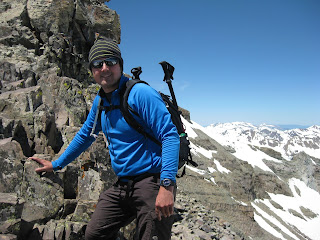
As long as I have been hiking, I have been drawn to the pursuit of peak bagging, or standing on the tallest place around.  And as long as I have been peak bagging, I have been drawn to bigger and bigger mountains, which eventually entered the realm of mountaineering.  Some people say the phrase "mountaineering" or "mountain climbing" and they get these visions of climbing Everest or K2.  Some people would consider the Chimney Tops trail in the Great Smoky Mountains National Park a mountain climb.  The distinction between hiking and mountain climbing is a very blurry one.  Because I have had the opportunity to dwell on the matter through miles and miles of weary trail, I have decided that the distinction depends on either the use of your hands for rock scrambling and/or the presence of  real seriousness.  The scrambling part is easy to understand. The seriousness part will be quickly be discovered the first time you go up the hill.  On a mountain climb, time is serious.  Of course additionally, water is serious.  Food is serious.  Gear is serious.  Physical conditioning is serious.  Weather is serious.  Planning is serious.  Navigation is serious.  I don't know of another physical endeavor that challenges your physical strength, mental acuity, and general courage the same way that a big mountain does.  I like to describe it as running a marathon, while playing a game of chess, and being chased by a grizzly bear.  Hey, this is fun stuff! 

Anyway, I know it might be easy to look at the pictures from some of these mountain trips and think it looks intimidating.  But it really shouldn't be.  I am a believer that the mountains have something to offer everyone.  So here are a few pointers for anyone wanting to give it a try.  There is great mountaineering country all over the western U.S. (Rockies, Sierras, Cascades), but the rest of this is a little Colorado-centric because I have the most experience there.   

1) Mostly, it is just typical hiking.  When you start reading about the routes up various mountains, they will be likely described with the YDS, Yosemite Decimal System.  The YDS uses the terms Class 1, Class 2 and 2 +, Class 3, Class 4, and Class 5.1 and up.  Class 4 and Class 5.1 and higher are typically the realm of technical climbing using protection and ropes.  Unless you have specialized skills, you should stay off these routes.  You can summit almost all of the 14,000 ft mountains in Colorado without touching a Class 4 or higher route. 

The break down is such:

Class 1:  That is a trail like every other trail you have been on.  Even the standard routes on the "hardest" mountains will be usually be mostly Class 1 on the lower parts.  In fact, on many mountains you could just follow the Class 1 trail as high as it goes and get a pretty good adventure out of it.  And there are many Colorado 14ners with Class 1 trails all the way to the top.

Class 2:  This is off trail hiking, typically through loose rock called talus or larger boulders.  Occasionally you might put your hand down for balance, but it is really mostly rock hopping. 


                               The "Trough" on Longs Peak


Class 2+: This is using your hands for hand holds and making basic climbing moves.  The holds are easy to find and most people feel comfortable facing out when descending.


                         Old Rag in Shenandoah National Park


Class 3: This is using your hands for hand holds and making basic climbing moves.  The holds are still easy to find, but the conditions are such that most people feel comfortable facing in when descending.


                               Estes Cone near Estes Park, CO


2) The gear is really simple.  If you already hike or do almost anything outside, you already probably have the clothes.  A synthetic fleece and a Gore-Tex shell is mainly all you need.  You always need the rain gear no matter what the temperature.  The shoes can be trail runners, trail shoes, or boots. Your day pack doesn't have to be anything special, but I like anything that holds a camel-bak or something similar to make drinking easier (good hydration is a defense against altitude sickness).   For longer climbs, I am a big believer in trekking poles.  When hiking in the east, I have never bothered much with them.  But when you are high above the tree line in the thin air with shaky legs, you will appreciate the extra stability and the almost "4wd motion".

I haven't really mentioned snow, because for most big mountains in the Rockies and Sierras, if you go in the peak climbing season, Mid-July through Mid-September, you won't encounter much snow.  If you do go during the spring or early summer, you may encounter a significant amount of snow.  If it isn't that steep or deep, you will be ok with just your trekking poles and maybe snow baskets on the ends.  If the snow gets more serious, you will need gaiters, extra traction (mirco-spikes or crampons), and a basic mountaineering ice ax.  Snow climbing skills can be learned quickly by taking a simple snow school that is mandatory on a guided climb.  The Cascades are a great place to learn this stuff because of the amount of snow they receive. 

3) Pictures can be really, really deceiving.  Honestly, this is one of those things that you will only understand after going out a few times.  It is really easy to look at some pictures and think things look super easy.  Most likely they ain't.  And on the other hand it is really easy to look at some pictures and think something is crazy impossible.  Most likely it ain't either.  I have learned this lesson the hard way (the main way I learn lessons) and I will always pick the easiest route the first time I visit a mountain.  You can read all the guides and look at all the pictures but until you stand there in person it is all academic.


               It just looks like a snowy hill behind me, but that
                         is Mt. Hood.  Spoiler alert: It is not easy 


                       This is the Home Stretch on Longs Peak. 
                   I always thought this picture made it look crazy.  
                                  It really wasn't that bad.


4) It really isn't that dangerous.  I know I mentioned that "being chased by a grizzly bear" part, but when you really drill down to it, it isn't more dangerous than probably ten other activities you do already.  Lot of things are dangerous.  Lawn mowers are dangerous.  Boats are dangerous.  Shooting is dangerous.  Cooking with a propane grill is dangerous.  Don't even get me started on driving.  Just like all that other stuff, you just have to be careful and respectful of where you are and what you are doing.  If you take it serious and be careful, you have a much greater chance of getting hit by a car in the trail head parking lot than you do of something happening on the actual mountain.  

Anyway, if you find yourself out west near some big'uns, and the season is right, give it shot.  Keep putting one foot in front of the other.  Even if you don't make it anywhere near the top, you will get some cool pictures for social media.  And isn't that the whole point of doing anything???? 

                          Because this shot wasn't staged at all

Thursday, May 4, 2017

Trout Fishing. Yes We Can!


When I was a kid I remember watching A River Runs Through It and being amazed at the whole concept of trout fishing.  Of course there was the whole fly rod theatrical stuff, but I was also amazed at the idea of standing in a rushing river of clear water with rocky shores and fishing for something that seemed so exotic as a trout.  Growing up in West Tennessee, we fish for crappie, brim, perch, large mouth bass, and catfish.  Those fish are all fine for eating, but trout were served on menu's in fancy places, like Red Lobster.  Also, I grew up fishing in lakes, ponds, and Tennessee River backwater, all still water with very limited visibility below the surface.  The whole idea of fishing in a river where you could possibly see what you were catching before you had it almost next to you seemed exotic as well.  And even if I never caught a fish I just liked the idea of trying for it. I have always liked to stand or walk near rivers.  On backpacking and hiking trips, my favorite trails are the ones that follow rivers and streams.

So I am writing this from a base level of total ignorance. Everything I have learned over these past couple of trips on the Elk river has been through complete trial and error.  So here are a few of the things I have discovered along the way.

1) The fly rod stuff is not necessary and you won't be out of place if you don't fish that way.  Fly fishing is like learning to play the piano.  If you don't have the time and a place to practice, it is going to be pretty hard to just pick up, and it is probably not worth buying entirely new gear if you are only going to be around trout one or two times a year.  All you really need is a normal rod and spinning reel set up and you will be fine.  There will be plenty of other folks using them.  The guys that are flying fishing will still look cooler though.

2) Trout streams are relatively easy to find.  Your state wildlife agency website will tell you where to find them.  The main reason for that is because they want to sell you a special license.  Most likely your normal fishing license is not going to cut it.  There probably are several options for the trout "stamp", from day permits, to all species endorsements, to maybe even special rates for tourist zones (in Tennessee, Gatlinburg has it's own special rate).

3) The best way to access them is from a canoe or kayak.  The public walk in accesses can be crowded, but if you have a way to stay mobile, you will have better luck.  Most trout rivers have canoe and kayak rental options if you don't have you own.

4) Lures are simple.  You will get a ton of advice, but from pure trial and error, I have seen that simple casting spoons and rooster tails work best.  If you don't live in an area with many trout streams, your local outdoor store will likely be stocked with 10,000 different kinds of bass lures.  You might be able to find rooster tails, but you will likely have to order spoons off the internet.  The big difference between these type of lures and bass lures is that trout are not going to be attracted to big, flashy, rattling, diving, swamp creatures like bass are.  Trout like simple and shiny.  If there is much current you will need 1/8th oz or heavier.  The really light lures get drug up to the surface in strong current.


If all else fails, you can cover a small hook with whole kernel corn, straight out of the can.

5) Trout are just fish.  They are not magical, they act like every other fish.  They find a place to not expend energy, they look around for food, then they strike.  The same concepts that apply to other sport fish work the same way.  Trout are going to find a hole or deep pool out of the current.  They might hide behind a large rock or a fallen tree.  When they see something that looks yummy near them, they will hit it hard.  The main thing to learn is how to deal with the current, which will just happen with practice.  Just keep putting your lures over the fishy looking places and they will find you.

So if you get a chance, give it a try.  If you catch a few that are eating size, grill them whole, over a wood fire.  I promise they will taste a lot better than the ones at Red Lobster.